
Club History | Fourteenth Hall of Fame - April 2026
Scott Wilson and Grant Jenkins were inducted at the Fourteenth Hall of Fame held at the Alhambra Theatre on 26th April 2026
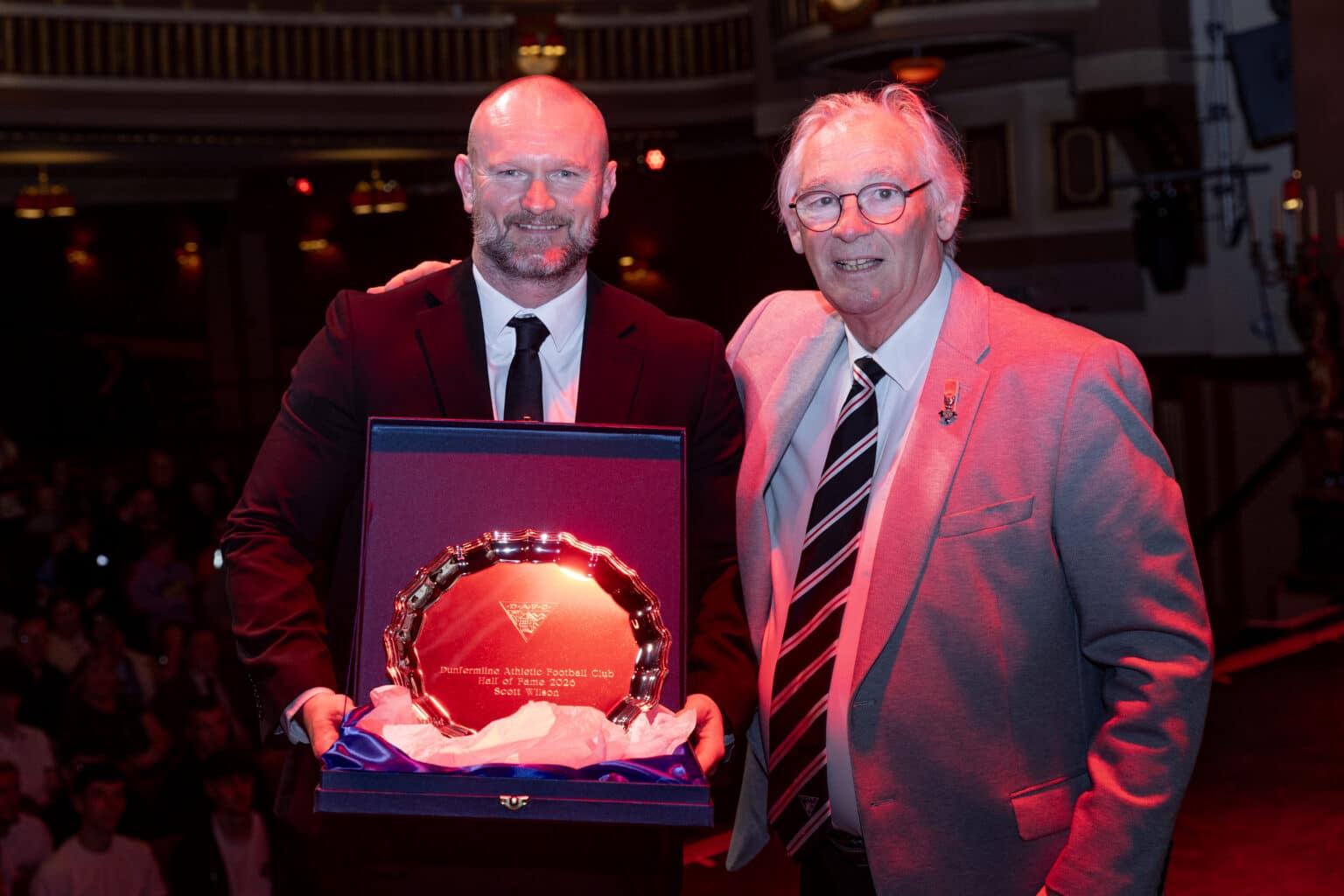
Two more Pars Legends join the Hall of Fame. Scott Wilson and Grant Jenkins. Read their career highlights and their reaction to joining the Dunfermline Athletic Hall of Fame.
Scott Wilson - Dunfermline Athletic Hall of Fame
There are signings that tell you something about a football club`s ambition, and Scott Wilson`s arrival at East End Park in August 2002 was precisely that kind of statement. That Dunfermline Athletic could attract a player of his calibre - in the face of interest from clubs far larger - spoke volumes about the standing the Pars had built for themselves at that time. For Scott, it was equally telling: he chose Dunfermline not despite its size, but because of what it offered him - a stage, a chance, and a club that believed in him.
Scott had come through the renowned Rangers youth system, signing for the Ibrox club in July 1993, and his development was rapid and impressive. He played Champions League football at the age of just 19 and earned Scotland Under-21 recognition - achievements that marked him out as one of the most promising young defenders in the country. By the time he departed for Portsmouth at the end of the 2001`“02 season, he had accumulated 78 appearances for Rangers, providing dependable, high-quality cover throughout. For a player of that pedigree, a move to England seemed the natural next step. But Scott Wilson had other ideas.
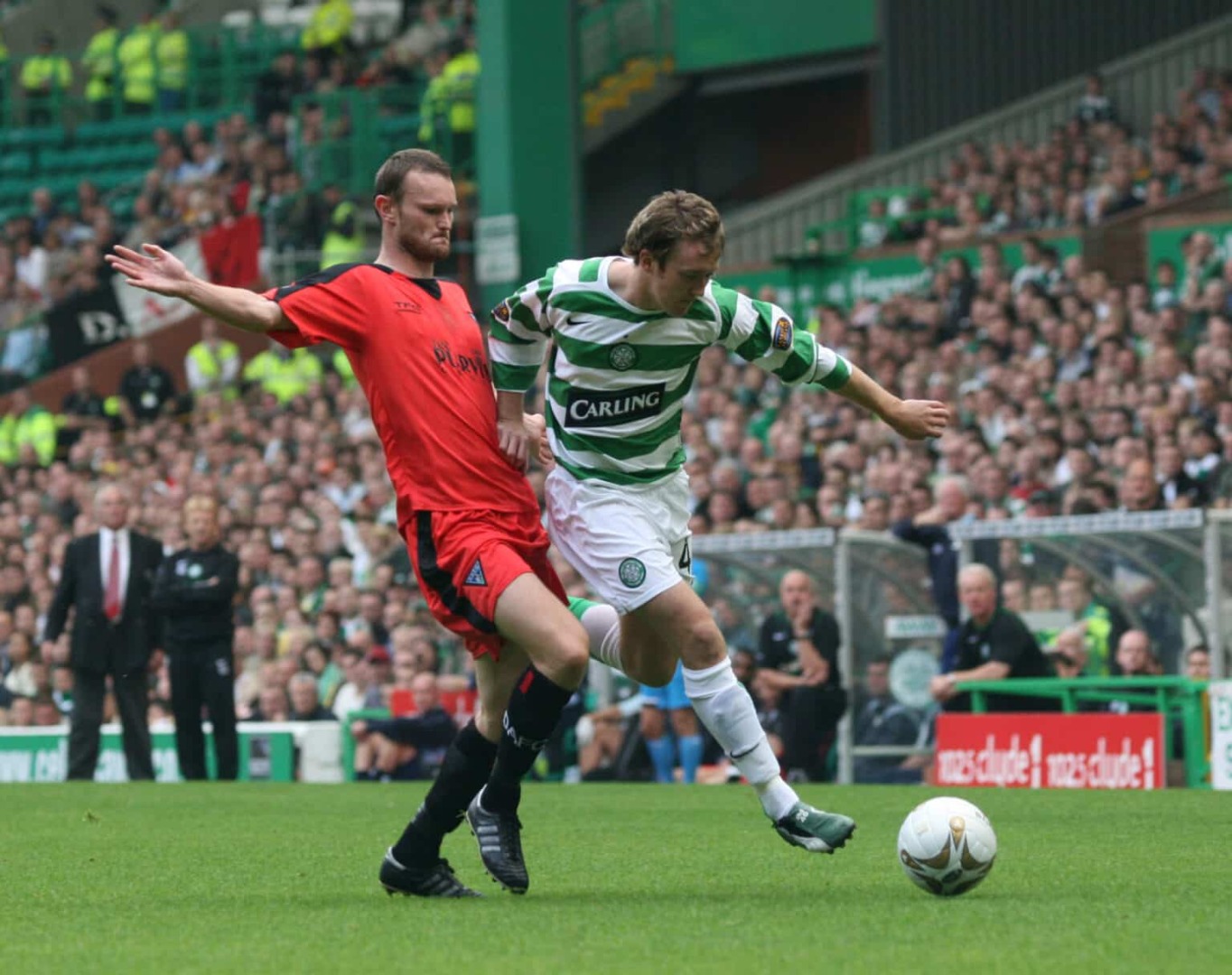
Nicknamed "Dinger" from his Ibrox days, he followed a path similar to that of Barry Nicholson - choosing regular first-team football at Dunfermline over the uncertainty of life as a squad player at a bigger club. It was a decision that would define the best years of his career, and one that Pars supporters came to cherish deeply.
From his debut against Rangers on 1st September 2002, Scott brought to East End Park everything that had marked him out as a player of the highest quality. A composed and commanding central defender, he combined aerial dominance with the kind of well-timed, intelligent tackling that breaks opposition attacks and steadies a team under pressure. He was not a showy footballer - he was something more valuable: a reliable, authoritative presence at the heart of the defence who made the players around him better and more confident.
His qualities were duly recognised at international level when he earned a Scotland B cap in 2004, having earlier won his place in Berti Vogts` Scotland Futures setup. Many who watched him regularly felt that recognition alone barely scratched the surface of what he deserved. Fate, though, had a cruel turn to play that same year: Wilson missed the 2004 Scottish Cup final through appendicitis, a cruel blow for a player who had contributed so much to the club`s run. It remains one of those painful footnotes that true supporters never quite forget.
If that was a moment of heartbreak, then the 2006`“07 Scottish Cup offered glorious compensation. Wilson scored the goal that eliminated Hearts - the reigning cup holders - a strike that captured everything about the man: purposeful, timely, and delivered when it mattered most. It was the kind of contribution that echoes through a club`s history.
His commitment to Dunfermline never wavered. He signed a two-year contract in 2007, weathered the difficulty of relegation, and was appointed Club Captain in 2008 - a recognition by the club of everything he represented on and off the pitch. His last goal came on 1st November 2008 against St Johnstone, a fitting late chapter in a Pars career of remarkable consistency and quality. He departed in May 2009 to take up a new challenge with Ian Ferguson`s North Queensland Fury, leaving after seven distinguished years with the club.
Scott Wilson gave Dunfermline Athletic seven years of professionalism, leadership, and genuine class. He arrived as a player who could have gone elsewhere and chose to give his best years to the Pars. That loyalty, combined with his talent and his character, makes his induction into the Hall of Fame not just deserved, but long overdue.
Welcome to the Hall of Fame, Dinger.
Scott Wilson gives his reaction to the honour.
Scott has described his induction into the Dunfermline Athletic Hall of Fame as "absolutely unexpected" and says he is "super proud" to be recognised alongside the names that have gone before him.
The former Pars defender, now 49, gave seven distinguished years to the club after arriving at East End Park in August 2002, going on to become Club Captain before departing for Australia in May 2009. His induction is a tribute to a career at Dunfermline defined by loyalty, leadership and genuine quality.
"Seven happy years, to be honest," Scott reflects. "Highs and lows, more highs than lows. Some fantastic boys, some fantastic people at the club who have been amazing. Nothing but happy memories, to be honest."
Scott Wilson arrived at a club already punching above its weight under manager Jimmy Calderwood and his assistant Jimmy Nicholl, and he insists the standard he found at Dunfermline matched much of what he had experienced before leaving Rangers.
"I came in at the right time, I came into a team that was already brilliant, to be honest. When you`d left a team like Rangers and you came down, I felt that the standard didn`t drop that much. Some of the boys in the team were real, real good players who potentially could have been at a bigger club, no disrespect to Dunfermline. A manager who was unbelievable and an assistant, the two Jimmies were just brilliant. When you`ve got all that, coming into training every morning, it`s a privilege, to be honest. On a Saturday, you just think you`re never going to get beat."
Those feelings were well founded. Wilson played in the 2006 League Cup final and the 2007 Scottish Cup final, and was part of a side that finished fourth in the top flight - a finish he believes could have been even better.
"Absolutely, we should have been third, to be honest. I felt that year we were probably better than Hearts. It was a strong Hearts team but we could have been third, there was not much between the two teams."
The 2007 Scottish Cup run remains one of the great Dunfermline stories, with victories over Rangers, Hearts and Hibs on the way to the final. Scott, who had missed the 2004 final through appendicitis, knows better than most what it means to fall at the last hurdle.
That experience gives added poignancy to the fact that Dunfermline now stand on the verge of another Scottish Cup final, set to face Celtic on 23rd May 2026. Scott is watching with great hope.
"To be honest, the boys have done it there. They`ve had similarly hard games. Let`s hope they can go one step further than we did, everybody wants that. I`d love to see it happen, to be honest."
His message to the current squad is simple and heartfelt:-
"Don`t get beat, to be honest. In the cup finals, I`ve been lucky enough to be in winning cup final teams and in losing cup finals teams. It`s not an enjoyable day if you get beat. It hurts, and it hurts for a while. There`s nothing you can do about it. Make sure they leave nothing on the path that they regret. Take everything away."
When the conversation turns to the Hall of Fame itself, Scott claimed:-
"This is absolutely unexpected. I`ve seen the names that have been on it. I`m absolutely over the moon. I`m super proud. Super proud."
He still follows the club closely, though his working schedule makes attending games difficult. "I always look for the results. Unfortunately, I don`t get to many games because my shifts are different. I don`t get many weekends off. Hopefully, in the next couple of years, I can start to get back to more games, to be honest."
After leaving Dunfermline, Scott headed to Australia to play for North Queensland Fury under former teammate Ian Ferguson, an adventure that was cut short by injury.
"I went to Australia for Fergie. It was a brilliant place. I never had much of a pre-season, I snapped my ACL in my third game and that was me. The team were a bit all over the place, to be honest. Off the park, it was nonsense. On the park, I was injured, but the boys were really good. It was a brilliant place. It was a great experience."
In the years since, Scott has watched his two sons play rugby for Edinburgh at youth level, though both have stepped back from the game - one through a knee injury, the other now in his final year at university.
But it is Dunfermline that holds a very special place. And when Scott speaks about the club, it is striking that his warmth extends well beyond the dressing room.
"I just thoroughly enjoyed my time at Dunfermline. Not just the people who were involved in the football side. The people who made the club tick. Everybody - Joe Nelson, Kenny Arnott, the groundsmen Kevin and Willie. All these people who make the club tick who are never seen. They were all brilliant people.
"Even everybody in legends. My dad was at virtually every home game at Dunfermline, absolutely loved it and they looked after him really well. It was a privilege to play for that club, to be honest."
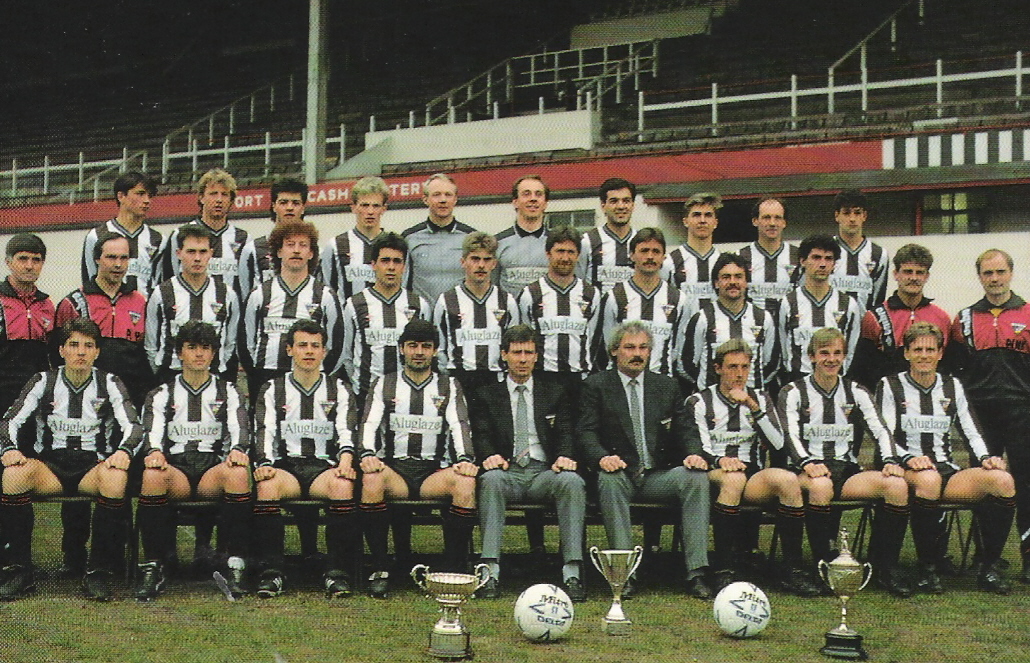
Above: Grant Jenkins photographed centre of middle row immediately behind Gregor Abel and Jim Leishman. August 1986
Grant Jenkins - Dunfermline Athletic Hall of Fame
There is something quietly fitting about the story of Grant Jenkins. Football has always been a game that rewards the late developer, the player who finds his level not through the well-worn conveyor belt of youth academies and reserve leagues, but through graft, perseverance, and an unfashionable belief in his own ability. Grant is that player - a man who was still turning out for junior football in Perthshire at an age when most professionals are already established in the senior game, yet who went on to become one of the most fondly remembered figures in Dunfermline Athletic`s history.
Born in Crieff on 11 April 1958, Grant began his footballing life with local side Crieff Earngrove at the age of sixteen, remaining there for six full years before graduating to Jeanfield Swifts. It was at Jeanfield that the goals began to flow in earnest, and it was there that Pars scout Ned McGeachie took notice.
On McGeachie`s recommendation, Jenkins was brought to East End Park for a trial, and manager Pat Stanton wasted no time in signing him in February 1981. He was twenty-two years old. Within a fortnight he was in the first team, lining up against Hibernian in the First Division. By the end of March he had opened his league account against Motherwell. The journey from Perthshire junior football to the professional game had been long, but Grant Jenkins had arrived.
The nickname "Shaggy" - a reference to his distinctive beard - stuck throughout his East End Park career, and with it came an affection from supporters that went well beyond the goals he scored. Jenkins was never simply a finisher; he was a creator, a worker, a player who understood that his value to the team extended beyond the tally in the record books. He harried defenders, held the ball up under pressure, and fashioned openings for teammates with a selflessness that endeared him to fans and fellow professionals alike. Those who watched him in his prime speak of a forward whose contribution was always greater than the raw statistics suggested.
Yet the statistics are themselves worth celebrating. Over six seasons at East End Park, Jenkins made 244 appearances in all - 193 starts and 51 as a substitute - and scored 52 goals, including 47 in the Scottish League. These are the numbers of a consistent, reliable performer, a player a manager could depend upon.
The undisputed highlight of his Dunfermline career came in the 1985`“86 season, when the Pars won promotion back to the Premier League. Jenkins was central to that campaign, forming a productive and complementary forward partnership with John Watson that became one of the defining features of the promotion push. The two strikers dovetailed beautifully - Watson the focal point, Jenkins the industrious foil - and together they gave Dunfermline an attacking threat that the First Division struggled to contain. It was, by any measure, a season to savour, and Jenkins was at the heart of it.
His path was not always straightforward. Competition for places at East End Park grew stiffer as the years passed, particularly with the arrival of Eric Ferguson and Ian McCall, and there were periods when Jenkins found himself on the periphery of the squad. Travelling difficulties and personal pressures added to the challenge. On more than one occasion a move away - most often to St Johnstone - seemed imminent, only for the deal to fall through and Jenkins to return to the fold, invariably producing a display of sufficient quality to remind everyone why he belonged. That capacity for a timely, decisive performance is the hallmark of a footballer with real character.
His final game for the club came on 21 November 1987 against Celtic in the Premier League, a fitting stage for a curtain call. He subsequently moved to St Johnstone, the club that had long seemed his most likely destination, and continued his career there. But it is the black and white of Dunfermline that Grant Jenkins will always be associated with.
The Dunfermline Athletic Hall of Fame exists to honour those who have given exceptional service to the club and left a mark on its supporters that time cannot diminish. Grant Jenkins - journeyman junior, willing workhorse, scorer of genuine beauties, partner in promotion, and irreplaceable "Shaggy" - belongs in that company without question.
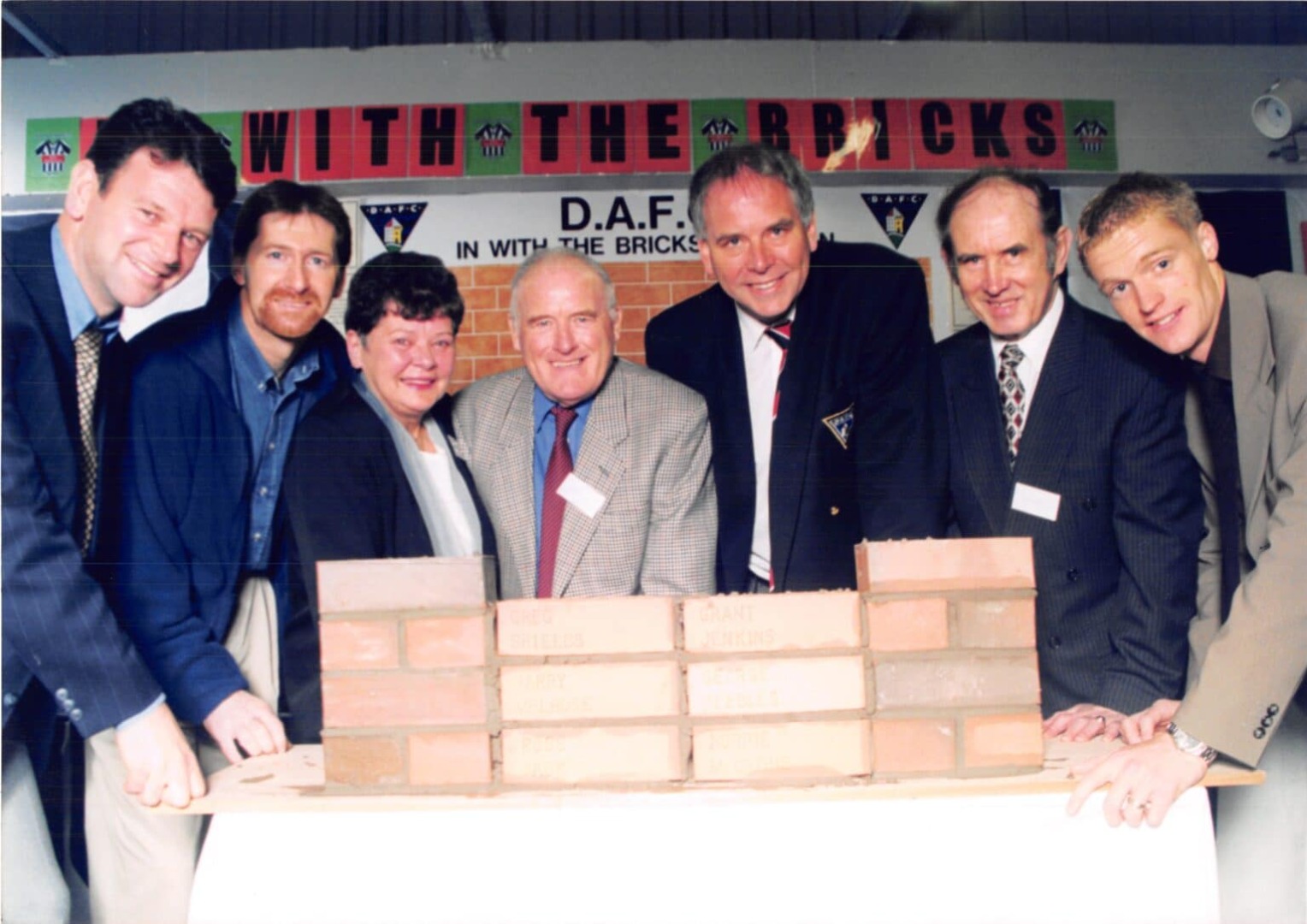
Above: In with the Bricks launch `“ Left to right: Ross Jack, Grant Jenkins, Mrs McCathie, Harry Melrose, John Yorkston, George Peebles and Greg Shields
Grant Jenkins was visibly moved as he reflected on being inducted into the Dunfermline Athletic Hall of Fame, describing the honour as coming completely out of the blue for the man who made 244 appearances for the Pars after taking a path to professional football that few could have predicted.
Grant who was still turning out for junior football in Perthshire at an age when most professionals are already established in the senior game, admitted the call from the club left him speechless.
"I`m so delighted with it, it is a privilege. It came out of the blue. Chris phoned me and I was just flabbergasted, it was just lovely to get it. To come down here and meet people who still remember you from when you played which is fantastic. So yeah, I`m absolutely delighted, couldn`t be more delighted."
Born in Crieff on 11 April 1958, Jenkins began his footballing life with local side Crieff Earngrove at the age of sixteen, spending six full years there before moving to Jeanfield Swifts. It was at Jeanfield that the goals began to flow, attracting the attention of Pars scout Ned McGeachie, and within months Jenkins found himself lining up against Hibernian on his debut after joining Dunfermline in February 1981.
"Crieff Earngrove, and then I went to Jeanfield for seven months, and then within a month I was playing junior football, and the next thing I was lining up against Hibernian in my debut. I couldn`t believe it but it was great. I thought I`d missed the chance. I had a few trials with clubs that never got anywhere, and then got the chance, took it, and I consider myself very lucky."
His route into the professional game was unconventional, and Grant, now 68 years old, has never lost sight of how fortunate he was to get his opportunity when he did.
"I was just 22 and thought I`d missed the boat to get a shot at professional football and then got the chance and then all of a sudden, seven years, and a title."
Over six seasons at East End Park, Grant Jenkins made 244 appearances in all and scored 52 goals. His time at the club spanned one of the most transformative periods in Dunfermline`s history, and he reserves particular praise for manager Jim Leishman, who he credits with turning the club`s fortunes around.
"There`s quite a few memories, obviously, not great at the start, we struggled for a couple of years, but then, I say it all the time, when Leish came in, it was just on the up all the way, and there was just so many highs. Winning the Second Division, then a bit of a low because we threw away the First Division title, but then up to the Premier League, great start, beat Celtic. It was just fantastic times, big crowds, they went from about 1,500 to about 16,000, quite incredible, and it was just a great time to be at the club."
He is equally keen, however, to recognise the contribution of Leishman`s assistant Gregor Abel, who he feels does not always receive the credit he deserves.
"Gregor did a lot, a lot of teamwork, a lot of coaching, definitely Gregor had a lot to do with it. I know the manager gets all the plaudits, but Gregor definitely had a lot to do with it as well. The way we trained was good and everything changed when Gregor came in was brilliant, really good."
The crowning moment of that era came with Dunfermline`s return to the top flight, and Grant still recalls the emotion of that first Premier League match, a 3-3 draw with Hibs on 8 August 1987, with great warmth.
"That first game, what a game. It was three all against Hibs, and a massive crowd. My only regret is although I set up a goal in the Premier League, I never scored in the Premier League, which is a big disappointment. It`s still a great experience to be playing against players who were Scottish internationalists."
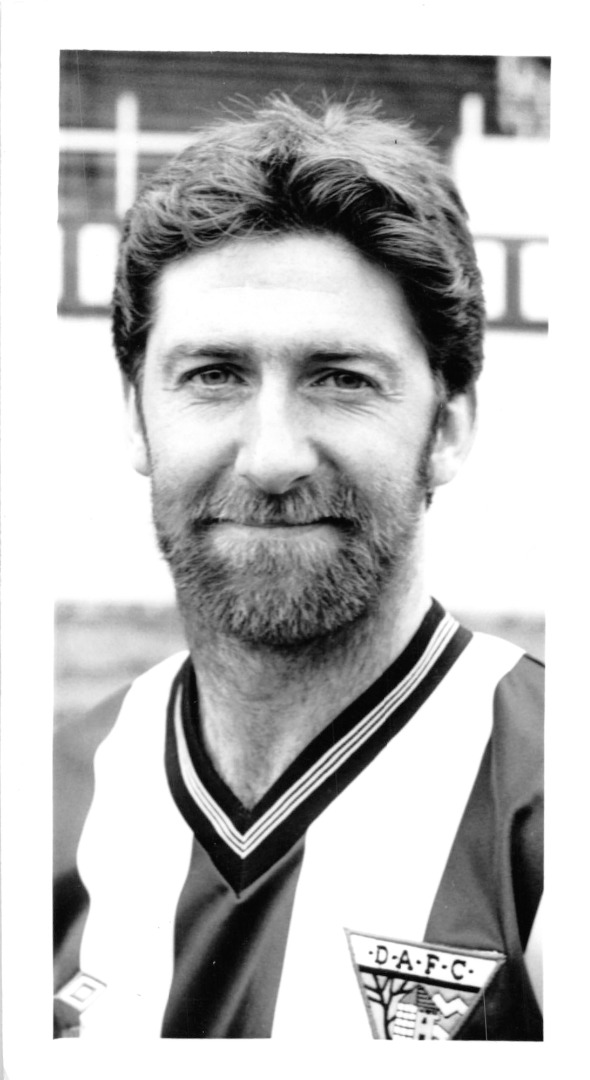
For much of his time at Dunfermline, Grant was combining football with working in his father`s scrap metal business near Crieff, making the journey to East End Park three times a week to train. He went full time only when the club reached the Premier League, and he looks back on the decision with admiration for his father`s encouragement.
"I started off part time, but it was hopeless because you trained yourself, you didn`t see anybody, so I just spoke to my dad and I said, look it`s not going to work, what do you think? And he says, oh, just go for it. I did, it was good."
Grant left Dunfermline in February of the Premier League season for St Johnstone, a club just ten miles from his door, and went on to win the First Division title there alongside former Pars colleague Kenny Thomson. He is philosophical about how fortune plays its part in a footballer`s career.
"I played with Kenny Thomson at Dunfermline and St Johnstone. I was in the game professionally for ten years, and the First Division title with St Johnstone was Kenny`s first trophy in 20 years in football, so it shows how lucky you could be depending on where you are at the time. No, not everybody in football wins things. So I consider myself very lucky, just to be at Dunfermline at a great period in time."
After hanging up his boots, Grant returned to work with his father and is still involved in the business today, though he says retirement is now on the horizon. While his visits to East End Park have been infrequent in recent years, the Hall of Fame induction has reignited his connection with the club.
"When you do come down and you go up to the Legends bar, and meet all the old fans, they want to speak to you, you cannot believe they still remember you. It is absolutely brilliant. I`m a Pars fan now, not a St Johnstone fan. I`m a golf fanatic, but I`ll definitely come down to more games next year."
For a man who once feared he had missed his chance in the professional game entirely, the recognition means everything.
"I was just so lucky to be there at a successful period. You know, it was tremendous."
views: 776