
News and Events | East End Park | The Stadium and its Evolution
In August 1903 the club opened a new ground slightly to the east of the first, almost on the site of the current stadium
Since the club was formed in 1885, the fans of Dunfermline Athletic have been "walking down the Halbeath Road" to see their team in action. Admittedly, in those early years, they didn`t have so far to travel, as the original ground was slightly nearer the town centre than the present stadium.
It was, however, about as far as the club could possibly go to distance itself from "the Lady`s Mill" ground of the initial Dunfermline F.C., from whom the Athletic split in 1885. It took a further two years before the new outfit could build a pavilion of their own at East End Park. Made of corrugated iron and lined with varnished wood, it measured only 30 feet by 12 feet and consisted of two dressing rooms, a bathroom and a meeting room. It may not have been much to look at, but the new pavilion demonstrated that the club meant business.
In August 1903 the club opened a new ground slightly to the east of the first, almost on the site of the current stadium. The Athletic didn`t own East End Park in those days and prior to the First World War, they began raising funds to purchase the ground or "some other suitable pitch in or around the town". There was obviously no affection built up at that stage by the club for its home! Strangely, as a move was a distinct possibility, a new stand and pavilion was opened in August 1913. Those buildings were to last nearly fifty years and believe it or not, some of the internal walls remained until the Main Stand was refurbished in recent years.
East End Park was finally bought by the Pars in 1921, with the club having taken out an overdraft of £3,500 to buy the land and a further three acres to the east. The pitch was moved slightly in that direction and was surrounded by a cinder track. The plans suggested that the so-called terracing on three sides of the ground could hold up to 64,000 spectators. The reality of this was undermined when Raith Rovers visited East End Park for the Scottish Cup tie two years later and two thousand tons of ash from Townhill had to be used to make the embankments less uncomfortable for the crowd of 12,000!
Due to the poor financial situation at the club during the 1930`s there was little done to improve the ground. The Supporters Club, however, contributed by building a new enclosure opposite the stand as well as installing a gas-powered hot water system.
The 50th Anniversary of Dunfermline Athletic, in 1935, saw the east banking terraced with wood from the liner "Mauretania", which was being broken up in Rosyth. Piecemeal work of this nature couldn`t hide the increasingly shabby state of the ground and by 1939 it was desperately in need of a facelift. It prompted a local paper into stating that "East End Park is no credit to the town and bad as an advertisement in our city!"
The Second World War ensured that no progress would be made until 1947/48 when the Board approved the purchase of three huts, one 72 feet long and the others half of that, to be used as a covered enclosure on the north terracing. In those days Pars fans were grateful for small mercies.
Things came to a head in 1950 when the Burgh Sanitary Engineer told the club to improve its pitiful sanitary conditions. From then on there was regular work carried out at East End Park, with the most noticeable change being the extensions built onto each end of the stand to provide an extra 1,000 seats. The cessation of ice hockey just along the road from East End Park meant that the Pars fitted out their new stand with 3,000 seats from the defunct ice-rink.
Following a long discussion concerning the ments of floodlighting, the Board finally gave it the go-ahead and a new addition to the town`s skyline was introduced. The £12,000 system was inaugurated on October 26th, 1959 with a match against Sheffield United.
The long-suffering Pars supporters probably thought that this was the height of the club`s ambition but they reckoned without Chairman David Thomson and fellow director Leonard Jack. Their appointment of Jock Stein to the manager`s chair completely transformed the Athletic on the pitch- now the Board had to ensure that the club had a stadium which could do the team justice.
After the last home match of season 1961/62, work began on dismantling the old stand. It wasn`t completely demolished as part of the pavilion was incorporated into the new structure.
The £65,000 Stand was ready for the opening home game of the new season, when 7,404 spectators took in a 3-3 draw with Kilmarnock, who were, ironically, the last opponents to play in front of the old stand. It goes without saying that this was a lot of money for the club at the time and any cash recouped from transfer fees went straight into paying for the ground redevelopment. The £23,500 received from Aston Villa in October 1962 for Cammy Fraser was very welcome indeed - not for nothing was the new stand jokingly referred to as the "Cammy Fraser Stand".
The During the first half of the 1960`s, Dunfermline spent around £150,000 on improving East End Park. Much of the work went in on unseen beneath the stand, such as the construction of a gymnasium, a cafeteria, kitchen, treatment room and press room. The north enclosure, having had a proper roof over its head since the late fifties, had two fifty foot extensions added to it in 1965, when it was also concreted for its entire length. The following year saw the west terracing covered, giving East End Park the distinctive look it enjoyed for over thirty years.
Having such an up-to-date stadium meant that when the lean years inevitably came, the ground didn`t fall into a similar state of disrepair that befell many others in the country.
But this didn`t prevent the club from having to make hurried arrangements for the Pars` first venture into the Premier League in 1987. Perhaps the surprise of promotion in two successive seasons and the growing spectator interest that had accompanied Jim Leishman`s meteoric rise had caught the club out, but it meant that just prior to the new season starting, new crush barriers had to be erected to ensure that East End Park received its safety certificate. Some poor fans at the opening Premier League match against Hibs felt the brunt of these emergency measures as they found themselves covered by the paint that had only the day before been applied to the new barriers! One welcome addition was the replacement of the turnstiles at the home terracing, while new seating was also installed in the Main Stand.
In 1989, Dunfermline`s growing commercial operation and the need for more seating meant that see were installed in the enclosures beneath the Main Stand, thanks to sponsorship.
The club`s first proper corporate hospitality suite was created within the Main Stand and was named the Jock Stein Suite in memory of Dunfermline`s greatest manager. The east terracing was also completely rebuilt. It had remained a relic from the past with loose shale filling in the steps that admittedly had at least now been created from concrete and not old railway sleepers. All of this had been done to try to retain the ground`s capacity under the new regulations at somewhere near the 23,000 mark. In the event the licence was for a capacity of 19,900. Unfortunately, the £250,000 spent on the project proved to be unnecessary, as within a year the Taylor Report (into the events surrounding the Hillsborough Disaster) paved the way for all seated stadia.
To ensure that the growing needs of television were catered for a new TV gantry was erected within the North Enclosure in 1990. Ironically after a number of years and various positions within the Main Stand, it had now reverted to the position it had originally enjoyed when first required in the 1960s.
At this point the club seriously considered selling East End Park and relocating to a purpose built arena at Pitreavie.
This was to have been a 14,000-seated stadium with leisure and other facilities included in the package. For a number of reasons, the plan fell through and the club decided on an ambitious plan to rebuild East End Park. Part of the reasoning was to ensure that Dunfermline Athletic would be in the frame when the new membership of the breakaway SPL was announced. It had decided on a number of strict criteria for SPL grounds, including the requirement that there be 10,000 seats.
_8540.JPG)
The first stage, carried out in 1997, was to remove the north terracing and to replace it with modern seating along its entire length. At the same time, the external parts of the Main Stand were getting a serious renovation - it was re-clad and spruced up, trees were planted and a new fashionable entrance porch installed. To ensure that the club`s lighting was adequate for live broadcasting, new powerful floodlights were erected in September 1997 and for the remainder of the season fans enjoyed the unusual spectacle of having two sets of floodlights siting alongside each other!
During the summer recess in 1998, work started in earnest on the new stadium. The east and west terracing were completely demolished, to be replaced by two new open view stands, each holding 3,000 spectators. The west stand, in which home fans are housed, was re-named the Norrie McCathie Stand, in honour of one of Dunfermline Athletic`s greatest servants. Work continued in the undercroft of the Norrie McCathie Stand to create new changing facilities, laundry, rest rooms and offices for the players, management and match officials. On 9th August 2000, Arsenal provided the opposition in a glamorous friendly match to mark the completion of the project.
In the summer of 2001, and after various abortive attempts at providing pitch protection, the club finally installed undersoil heating to ensure they met another of those SPL criteria.
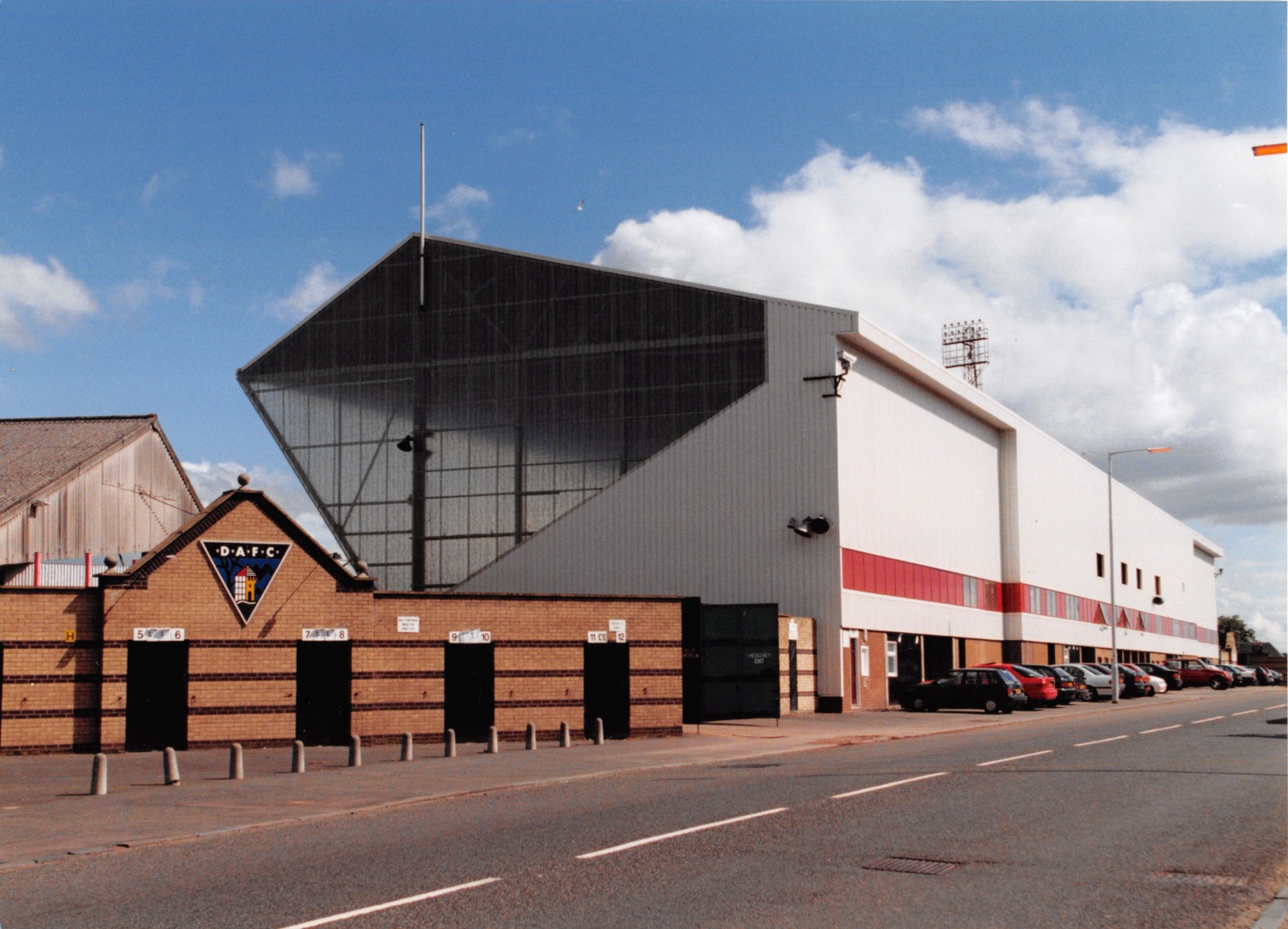
The following summer saw the Main Stand at last get the internal refurbishment it so desperately needed. A range of new function and conference suites are created, including the Kingdom Suite with its glass-fronted viewing boxes for corporate customers. A new Boardroom, new kitchens and bars are also developed, including Legends Sports Bar. The new facility also houses physiotherapy and beauty suites and a gymnasium.
The next piece in the `East End` jigsaw was also one of the most controversial and short-lived. After the first game of season 2003/04, Dunfermline were granted permission to rip up their grass pitch and replace it with a new state-of-the-art artificial surface, XL turf, manufactured in Canada.
Dunfermline received a large UEFA grant to enable this to happen and at the time appeared to have the support of nearly all SPL clubs as well as the footballing authorities. It was heralded as the way forward with the clear advantage of providing a surface that could be used for training and f commercial gain during the week as well as for matches at weekends.
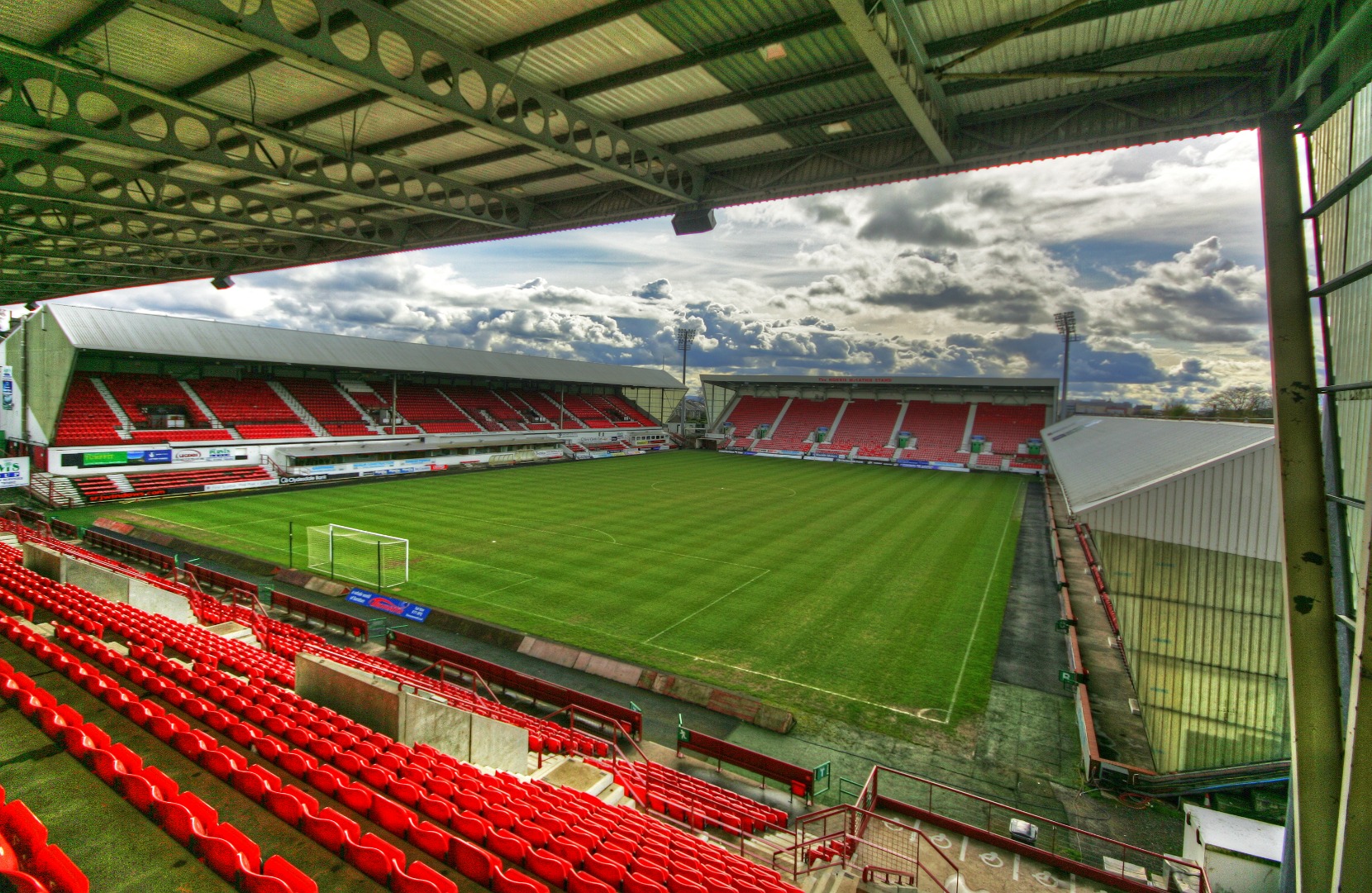
It didn`t take long, however, for there to be disquiet among other clubs and before long the Pars found themselves having to defend the pitch against some very exaggerated and unsubstantiated claims. The biggest disappointment for fans came on 26th August 2004 when Dunfermline were forced to play their first competitive European match for thirty years at McDiarmid Park in Perth because UEFA - the same UEFA that had provided the grant - would not sanction the surface for competitive use. The writing was on the wall and despite the manufacturers providing an improved replacement surface, and despite Dunfermline`s appeals, the club were forced to return to grass. The last match to be played on the artificial turf was a pre-season friendly match against Gretna on 16th July 2005.
In the early days perhaps any old footbell ground would have done to satisty the club`s needs, but no more. This is our home - everything that has happened to the club in the past years has its roots here. Think of all the great players, of all the clubs, who have graced the turf here, and the Pars legends whose names will always be synonymous with East End Park. This is their spiritual home equally as much as it is the supporters. Let`s hope that in another hundred years, the punters can still look forward to "Walking Down The Halbeath Road".
views: 1,683