
Club History | Alex Mitchell`s Silver Cigar Case
Alex Mitchell was the man who put Dunfermline Athletic on the map. He was the Chairman responsible in August 1919, for bringing Andy Wilson to play for Dunfermline.
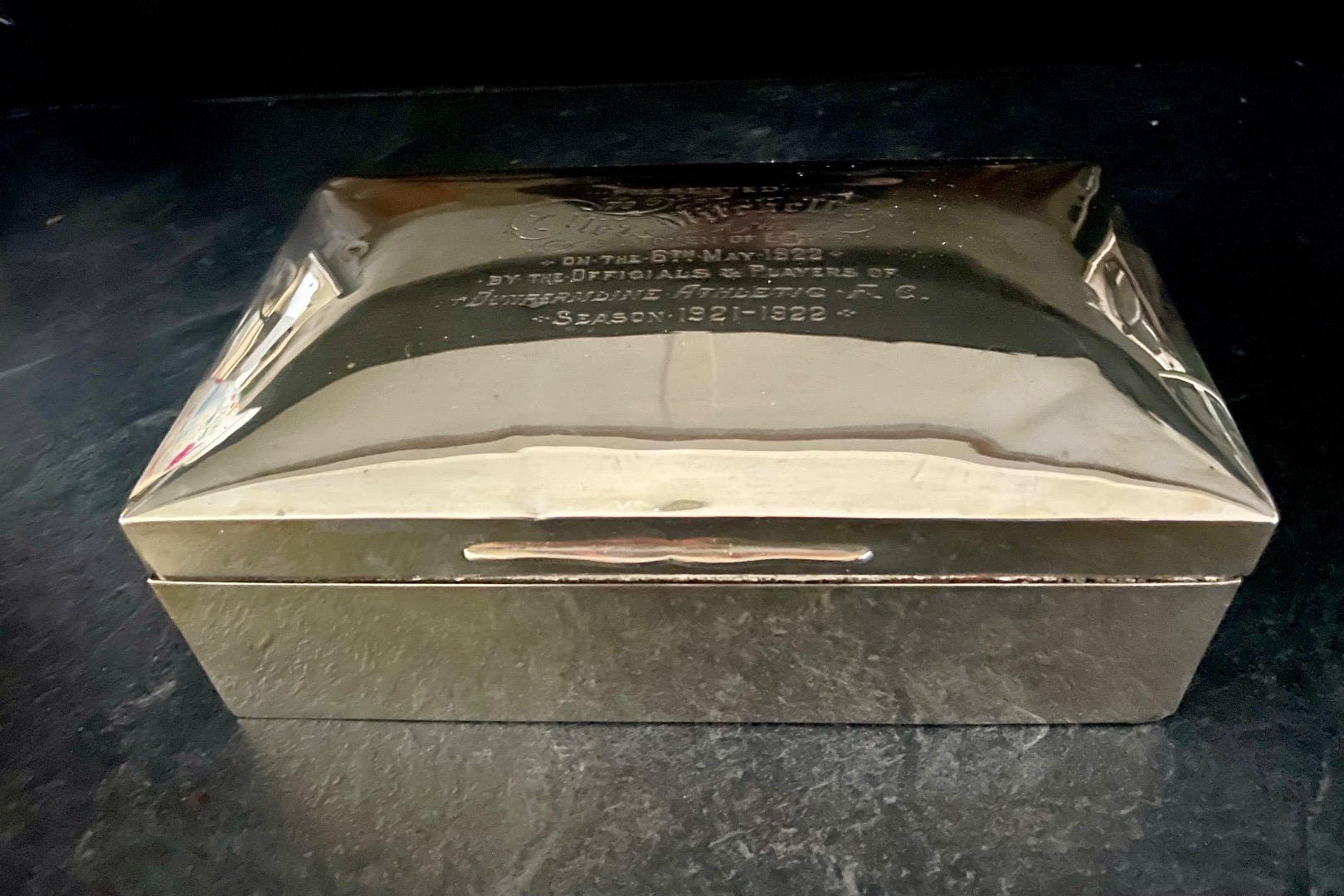
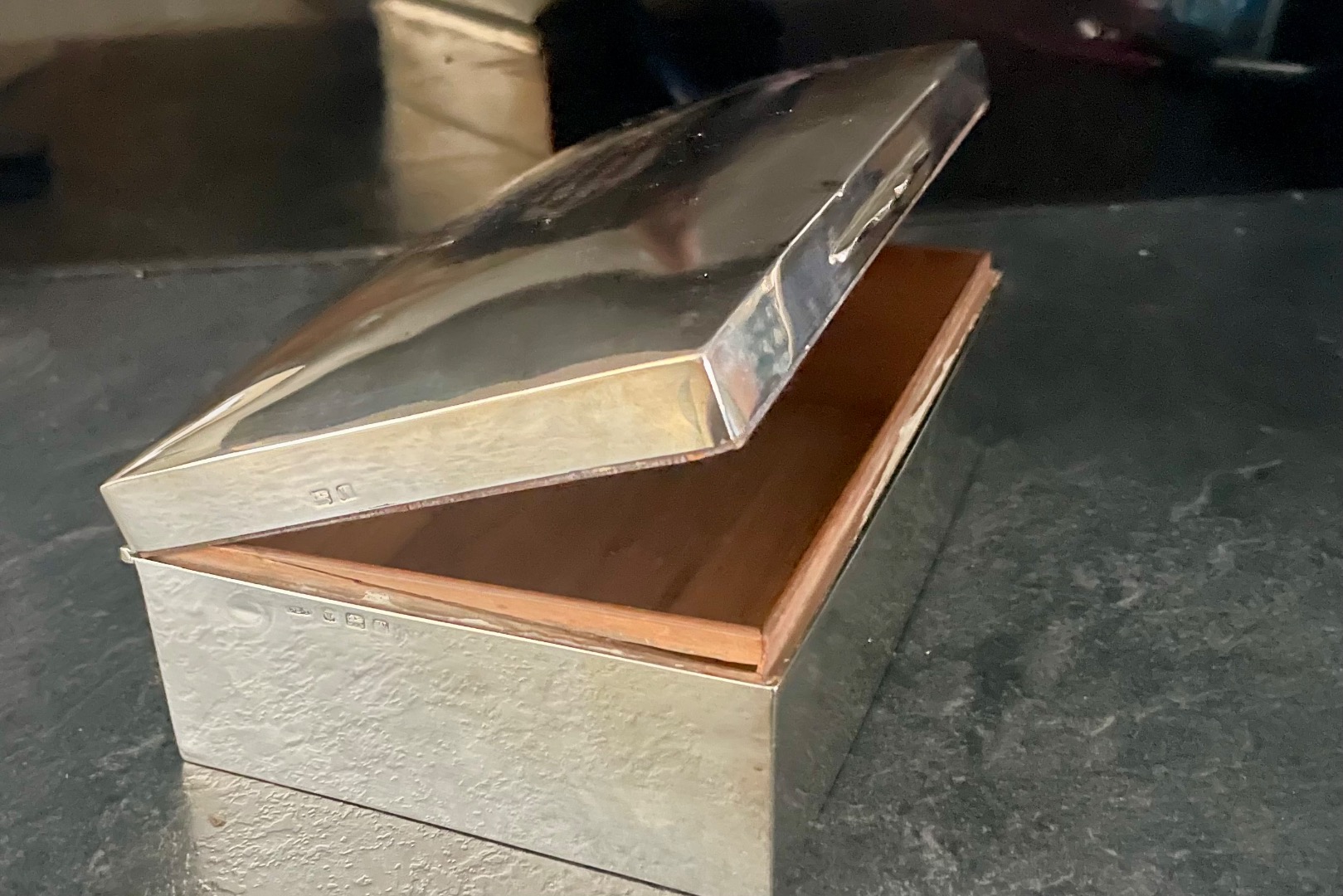
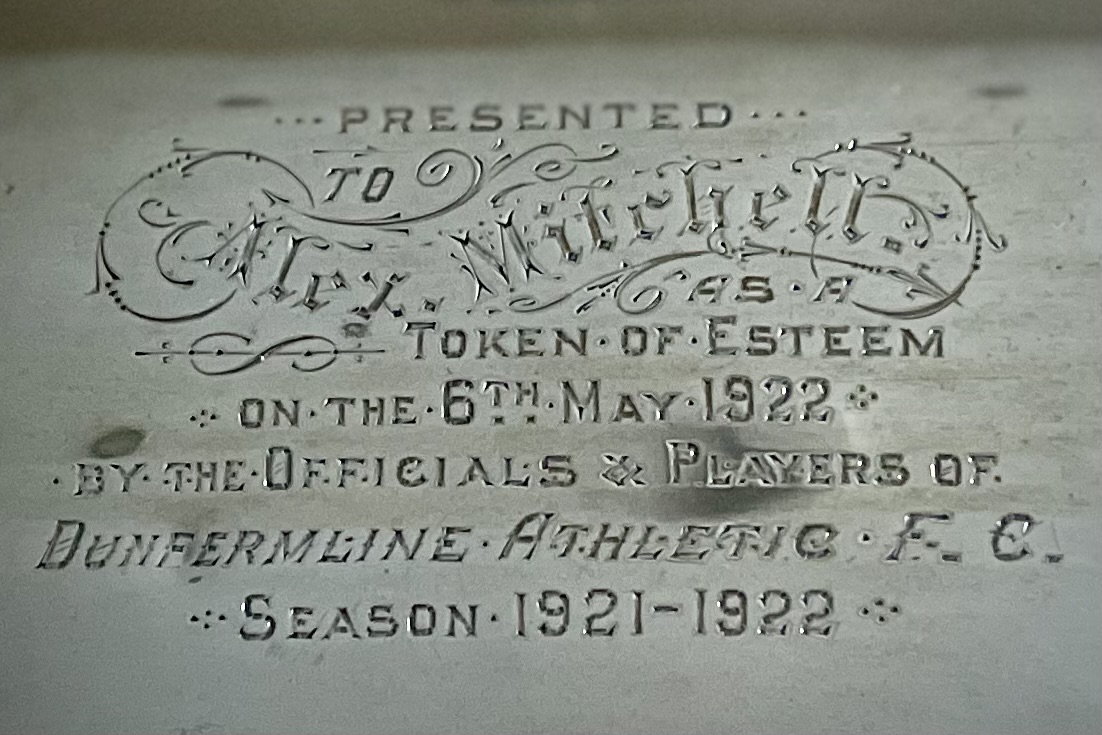
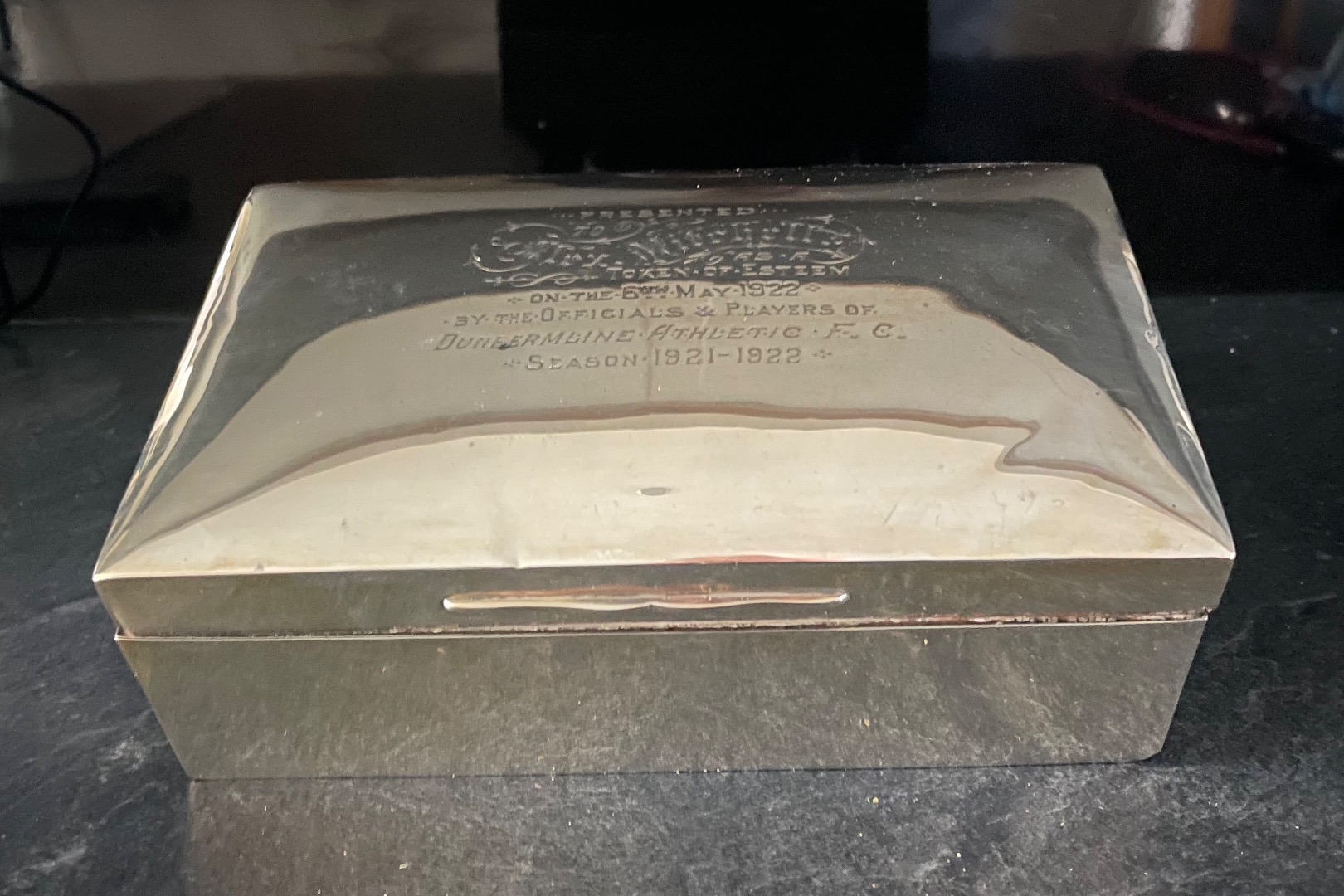
This silver cigar case was presented to Alex Mitchell as a token of esteem by the officials and players of Dunfermline Athletic Season 1921-1922. Alex Mitchell was the club`s first Chairman, holding office from 1919 to 1923.
In his book Dunfermline Athletic A Centenary History 1885-1985 John Hunter wrote:-
In 1919 it looked normality meant a return to the pre-war set up with no automatic promotion and relegation between the Leagues, Dunfermline and other ambitious clubs were having none of it. Proof of Dunfermline`s ambitions was demonstrated when a group of supporters realised that a voluntary committee running the club was not a realistic or sound proposition in the new, modern, post-war age that was about to dawn. Instead, they floated a limited liability company in 1919 with £3,000 capital raised through £1 shares; from the shareholders was elected a new board of directors empowered to raise money, by borrowing if necessary. The new Board comprised:
President - local joiner, Alex Mitchell; Secretary - William Whyte; J. Bewick, J. Belloch, J. Cousin, W. Simpson, J. Low, T. Burns, J. Anderson, J. Ritchie and G. Brooks.
The Board secured a long lease on their ground and planned to make it into one of the best in Fife.
Rather than revert to the unsatisfactory Second Division, Dunfermline and other aggrieved clubs formed themselves into the Central League, a body totally outwith the jurisdiction of the Scottish League and rivalling the Eastern League which they sponsored. Other teams lining up beside Dunfermline for the new 1919-20 season were: King`s Park, Hearts `A`, Bathgate, Alloa, Bo`ness, Stenhousemuir, St Bernard`s, Armadale, Broxburn, Clackmannan, East Fife, Falkirk `A` and East Stirling.
Since Dunfermline belonged to this "rebel" league they were able to attract players of merit to the club without any transfer fee being paid. This situation led to one of the greatest "transfer" coups of the century when Andy Wilson, then the country`s finest centre forward and valued around £2,000, signed for Dunfermline without a penny being paid. Today this would be like the Pars signing a Denis Law or a Kenny Dalglish for nothing.
From Newmains in Lanarkshire, Wilson originally played for Cambuslang Rangers before being transferred to Middlesbrough in 1913. During service in the army with the 6th HLI during the war he was badly wounded at Arras, shrapnel tearing into his left arm. Although he lost the use of that limb it did not prevent him from later becoming a very skilled billiards player at the Netherton Hall and he also represented England at bowls. While stationed in Scotland he played for Hearts but when the war ended and the Athletic heard that he might be available, President Alex Mitchell, using his own resources, managed to secure the forward`s signature. The signing was the talk not just of Dunfermline but of the whole of Scotland. Mitchell also helped him to establish a sports shop in Guildhall Street.
Starved of top class competitive football throughout the war, the public of Dunfermline flocked back to football in their thousands, glad to be rid of the heartache of war and Willing to be entertained once again on a Saturday after-noon. Dunfermline got off to an excellent start, beating Hearts `A` 7-1, Wilson netting four of them. A crowd of 5,000 turned up to see the Hearts match; football in the town was booming. A local reporter noted "queues of considerable dimensions were forming, many ladies seemingly having caught the fever".
By February, Wilson had scored 35 goals, including a double hat-trick, despite missing eight penalties. On one occasion he delighted the crowd by scoring with a header while lying on the ground. Wilson was seldom out of the headlines and his natural goal-scoring talent was recognised by the SFA when they chose him to play for Scotland even though he played in one of the lesser leagues. That season he was capped against Wales, Ireland and England, honours which were to be bestowed again during the following season to give him six full Scottish caps, a record for the club.
Dunfermline had an excellent season and were only just pipped for the championship by Bo`ness, leaving the Pars to rue the three points they dropped to wooden spoon lists Clackmannan. However, they did have the consolation of beating Cowdenbeath 3-1 in the Fife Cup final before a crowd of 10,505 at East End Park.
Confidence in the team was so high that the directors bought their ground and another three acres of land to the east for £3,500 in order to build, in effect, a new stadium. The pitch was moved further east and laid in the centre of the new field surrounded by a cinder track. The embankments (terracing would be too grand a description) on the north, west and east sides had space for up to 64,000 spectators, or so the plans suggested. To meet the cost the old company was converted into a public limited liability company with a capital of £12,000 divided into £1 shares.
The overwhelming success of the Central League finally persuaded the governing officials to give way and to concede the principle of automatic promotion and relegation.
For season 1921-22, therefore, the Second Division was resurrected and the Central League scrapped. Sadly for Dunfermline all their illegally signed stars had to be surrendered. Wilson returned to Middlesbrough. His beautiful ball control, his bullet shot, his guile, his dynamism and his sadly missed goalscoring feats - 100 goals in two seasons - were sadly missed not just by Athletic fans but by afficionados the game throughout Scotland. In 1923, Middlesbrough transferred him to Chelsea for £6,000, a very high sum in those days. He ended his playing career as the first British player to join a French club, Nimes, for whom he played from 1932-34.
Denuded of much of their talent, Dunfermline made, poor start to their new league campaign of 1921-22, falling to the bottom spar after only five games. Alex Mitchell, the club`s energetic chairman pulled off another surprise signing by bringing in a new goalkeeper, Arthur Halliwell from Canada, which caused quite a sensation in the days when overseas travel was rare.
William A. Knight, a publican from Rumblingwell, and the son of one of the original founders of the club, was appointed `Manager` of the club, the first person to be so designated. Previous to this the day-to-day running of the club and team selection rested with the secretary and the Board although they had surrendered some of their powers in January 1921 when they appointed a full-time trainer, Dick Vickers.
Also at this time a new Supporters` Club (reckoned to have been the first of its kind in Scotland) was formed, in part to help pay off the £3,500 debt on the new ground. At a well-attended inaugural meeting in the Co-op Hall, Dr Bell was elected chairman and soon 719 members had signed on.
In spite of these efforts the 1921-1922 season ended with the team only finishing eighth in the league and the club`s financial statement noted that the club lost £1,600 4s 3½d over the season. Visiting clubs to East End Park took away cheques to the value of £1,749 while Dunfermline only received £1,333 from their away matches.
Related Stories
views: 457